If you’ve tried getting clients on your own, some of this will sound familiar.
You’ve put real hours into getting good at editing. Then you open Instagram to look for a client, and there’s no clear next step: who to message, what to say, or what to do when nobody replies.
- You find a creator who looks promising.Then you spend twenty minutes wondering whether they’re actually worth messaging, and move on without deciding.
- You send “Hi, I’m a video editor.”It gets seen. Nothing comes back. Was it the person, the message or the timing? You can’t tell.
- Someone says “Sure, send me your portfolio.”You send it, feeling hopeful. Then silence.
- You get a “maybe later”.Is that a polite no, or a real later? You don’t know whether to check back in a week, a month, or never.
- You’re not sure what to do next.Follow up again? Try a different approach? Move on? Each option feels like a guess.
None of this means you’re bad at outreach. It means every step is improvised.
Prospecting feels inconsistent when there’s no structure underneath it. Effort isn’t the missing piece. A process is.
Why sending more DMs usually doesn’t fix it.
The usual advice is volume: more messages, a better template, your portfolio posted everywhere. But a message that could be sent to anyone gives the reader no reason to reply to you.
| Random prospecting | A structured pipeline |
|---|---|
| “Anyone who needs video editing” | One clearly defined target client |
| Scrolling profiles until something looks promising | A scored shortlist of 10–20 real prospects |
| “Do you need an editor?” | A message built on something you noticed in their content |
| Message once, then wonder | Follow-up with a clear rule for when to stop |
| Every reply feels like a lead | Need, content, timing and fit checked before you invest more time |
| Notes in your head | One tracker and a 30-day routine |
The second message only works because of the research behind it. That research is what the guide teaches, and you’ll see a complete example below.
Prospect-first. Opportunity-led outreach.
Seven stages. Each one sets up the next.
You choose the prospect first, find a real opportunity in their content second, and only then write the message. After that, you follow up, qualify, and keep track of the next action for every person.
- Right prospect
- Genuine content opportunity
- Personalised pitch
- Structured follow-up
- Qualified conversation
- Tracked pipeline
- 1Define the client and offer
Define
Pick one client type and a clear editing offer.
- 2Score and shortlist prospects
Find
Score prospects and shortlist 10–20 worth researching.
- 3Find the opportunity
Audit
Find one genuine short-form opportunity in their content.
- 4Write the message
Pitch
Turn that observation into a short, specific first message.
- 5Follow up
Follow up
Follow up with a clear rule for when to stop.
- 6Qualify
Qualify
Check need, timing and fit before you invest more time.
- 7Track the next action
Move forward
Run it as a 30-day pipeline and fix the biggest leak first.
- One-time payment
- Secure Razorpay checkout
- No subscription
One prospect, from first look to next step.
Here’s how the method plays out with one example the guide develops across Modules 4 and 5, with the Module 6 scorecard showing how you’d judge a reply. The difference isn’t a cleverer template. It’s the work done before the message is written.
Instructional example from the guide. Not a customer result.
- The prospect
An India-based productivity creator who publishes educational YouTube videos.
- The observation
A video explains five productivity lessons. The fourth lesson contains a clear, standalone idea.
- The opportunity
That fourth lesson could potentially work as a short on its own. So instead of “I edit Reels for creators”, the message focuses on the fourth lesson.
- The draft messageInstagram DM, as drafted in the guide
“Hey, I was watching your video on the 5 productivity lessons. The section about the fourth lesson stood out because it could potentially work as a standalone short. I edit this kind of talking-head content and thought it might be worth testing. Happy to share a similar example if useful.”
- Why it’s relevant
- It points to their actual video and a specific section.
- It connects that section to a short-form opportunity.
- It briefly explains why you’re relevant.
- It doesn’t criticise the creator or promise views.
- The ask is easy to say yes to.
- What happens next
If there’s no reply after a few days
The Follow-Up Decision Tree says: follow the planned sequence. Follow-up 1 brings back the same observation instead of starting over.
“Hey [Name], wanted to bring back the idea I mentioned from your productivity video. The fourth lesson could potentially work as a focused short on its own. Happy to share a similar example if useful.”
Still nothing after the planned follow-ups? Stop, and mark the prospect “No response / closed”.
If they reply
Respond to what they actually said. Then use the Qualification Scorecard: six areas, each scored 0–2, to decide whether this is a real opportunity.
9–12 Strong enough to move toward a commercial conversation. 6–8 Some potential. Ask only what you still need to know. 0–5 Probably not a strong opportunity right now. Consider stopping or keeping it warm.
From Modules 4, 5 and 6 of the guide. The guide treats the score as a decision aid, not a guarantee. A relevant message gives the prospect a real reason to read it; it can’t guarantee a reply.
What you’ll have built by the end.
The guide is made for doing, not just reading. As you work through it, you create a working pipeline:
- Your target client definitionWho you want to work with, in one sentence.
- A prospect listReal people who fit, recorded in your research sheet.
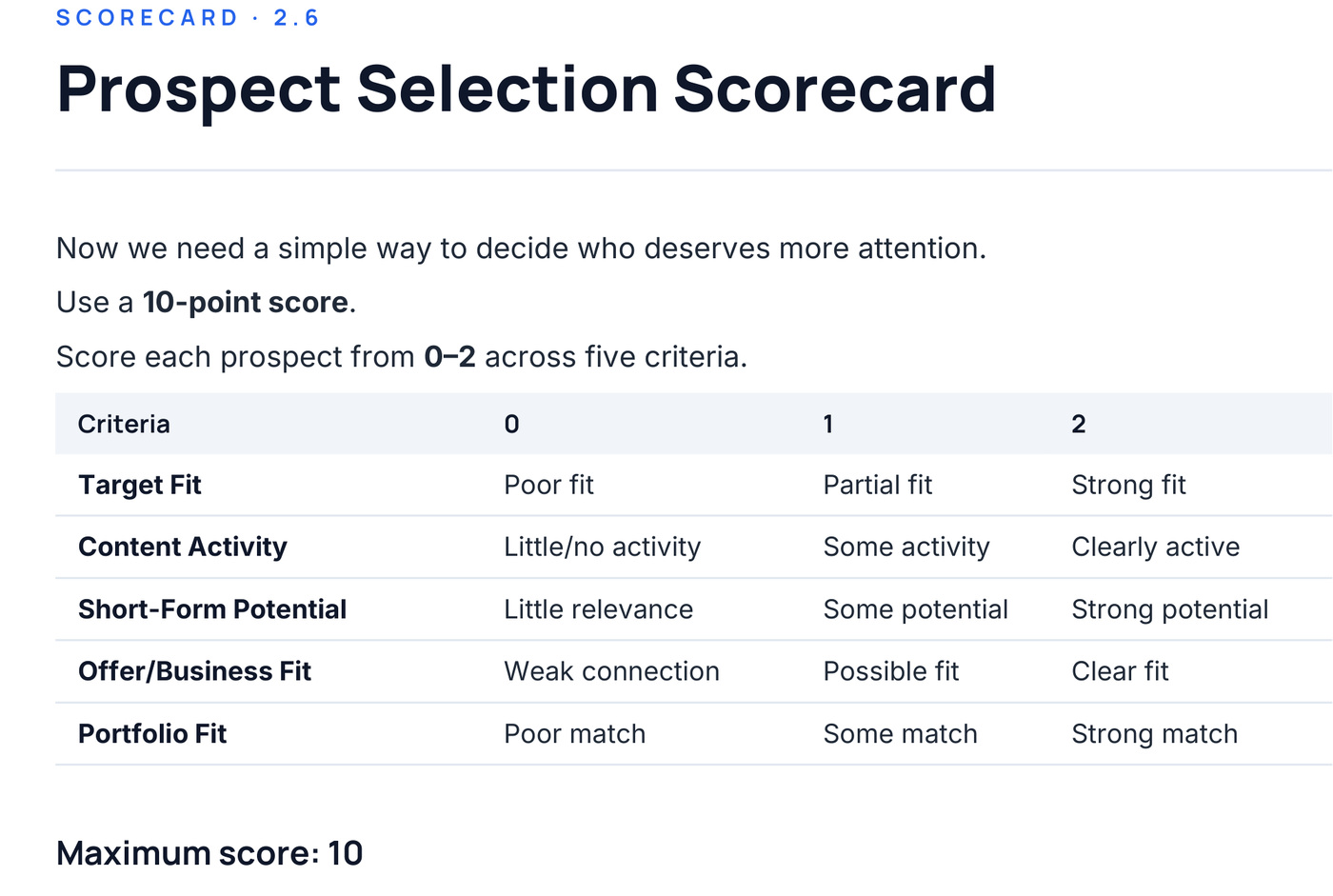
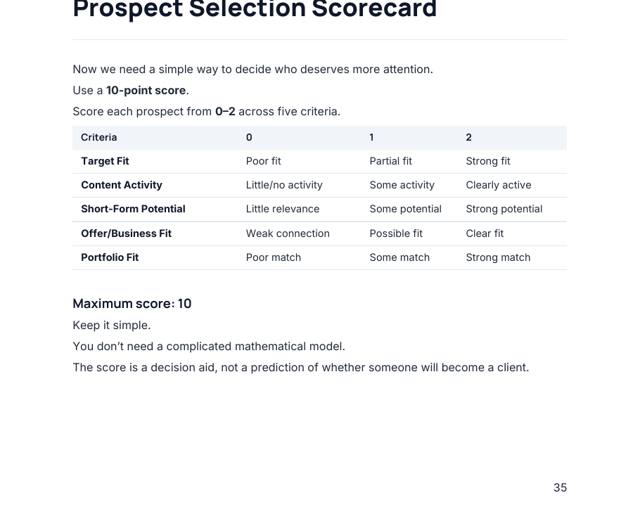
- Prospect scoresA quick, consistent way to decide who deserves your attention.
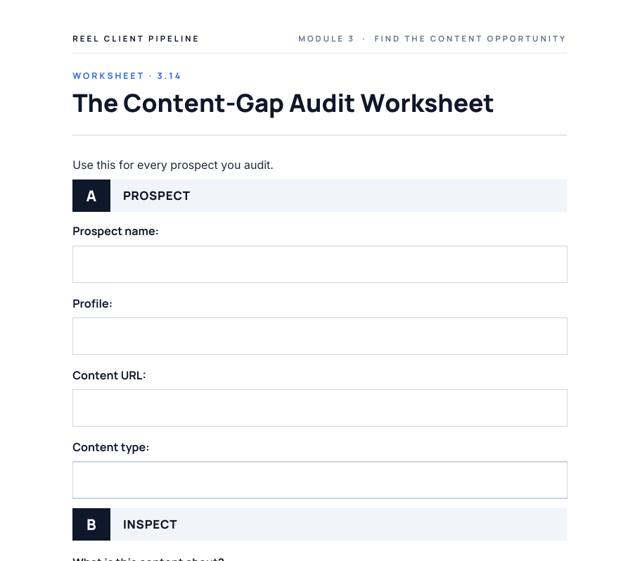
- Content auditsOne genuine opportunity per prospect, written down.
- Personalised pitchesFirst messages built on those audits.
- A follow-up planWhen to follow up, what to say, and when to stop.
- Qualification decisionsWhich conversations are worth pursuing.
- A pipeline trackerEvery prospect, their status and the next action, in one place.
- A 30-day routineWhat to do each day, and what to review each week.
What’s inside the guide.
It’s about 238 pages, but you don’t read it cover to cover. It works like a manual: you open the part you need for the stage you’re on.
How you use it
- Read Start Here, then the one-page Quick Start at the back.Together they give you the whole system and the daily routine before you begin Module 1.
- Work through the seven stages in order.One module per stage, from defining your target to running your pipeline.
- Fill in that stage’s worksheet before moving on.Each module ends with a completion checklist, so you know when you’re ready.
- Your pipeline builds as you go.Target, prospect list, pitches and tracker, ready to run for 30 days.
The 7-stage client-acquisition method
Seven modules, from defining your target to running your pipeline.
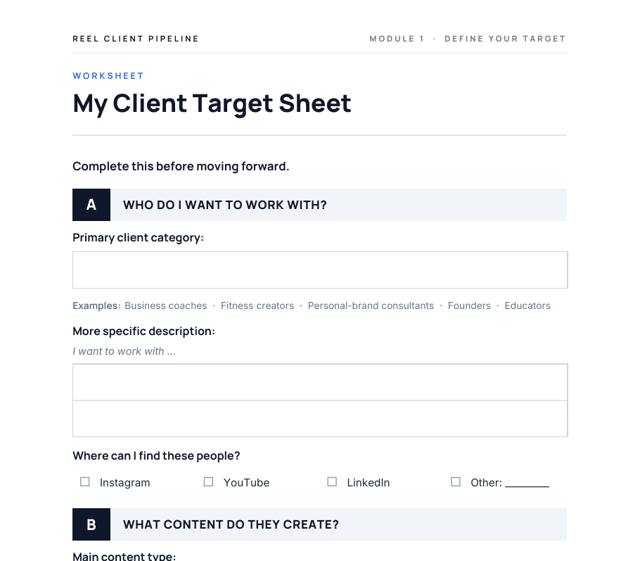
- Define Your Target
- Find Better Prospects
- Find the Content Opportunity
- Build the Personalized Pitch
- Send & Follow Up
- Qualify the Conversation
- Run the 30-Day Pipeline
Prospect research and selection toolkit
Decide who is worth contacting before you write a word.
- Client Target Sheet
- Prospect Selection Scorecard
- Prospect Research Sheet
Personalised pitch and follow-up toolkit
Find something real to say, say it, and follow up without chasing.
- Content-Gap Audit Worksheet
- Short-Form Opportunity Checklist
- Personalized Pitch Builder and Pitch Checklist
- Follow-Up Decision Tree
- Follow-Up Tracker and Follow-Up Worksheet
Qualification and pipeline management tools
Separate real need from polite interest, and see every prospect’s next action.
- Qualification Scorecard and Qualification Checklist
- Conversation Map
- Simple Pipeline Tracker
- Pipeline Leak Diagnostic
- “What Should I Improve Next?” Decision Tree
30-day implementation system
Turn the method into a routine you actually run.
- 30-Day Pipeline Planner
- Daily Activity Tracker and Weekly Review Worksheet
- Module completion checklists and one-page Quick Start
- Worked examples for a creator, coach, personal brand and small business, plus starting from zero
Look inside: one page from each stage.
These are actual pages from the guide, not mockups.
Swipe to see all seven pages.
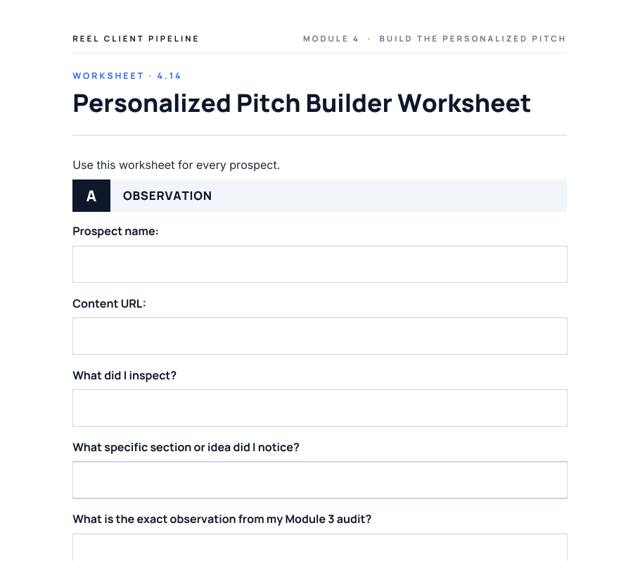
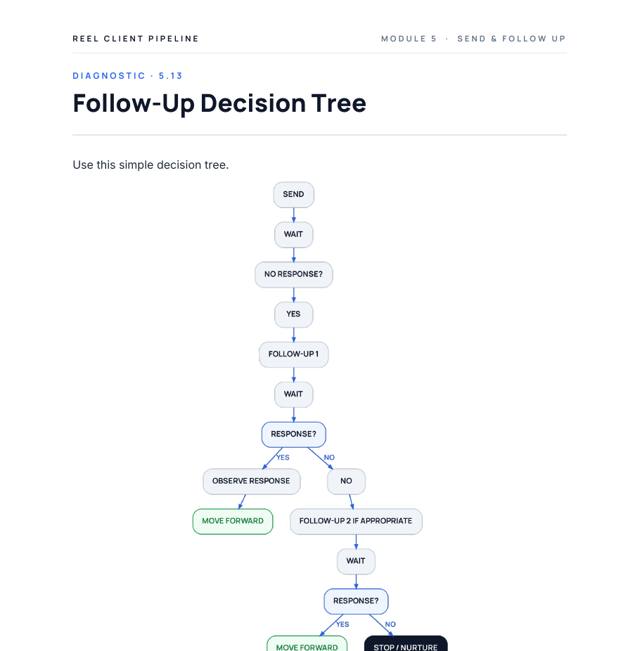
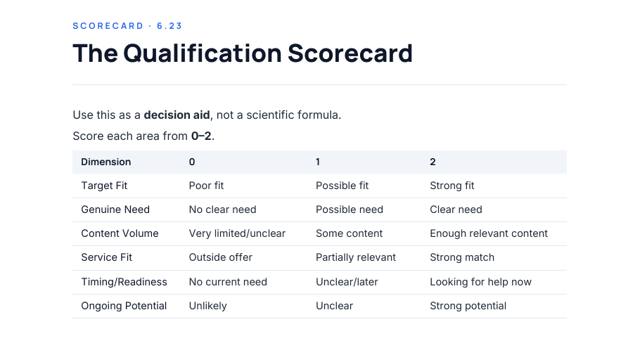
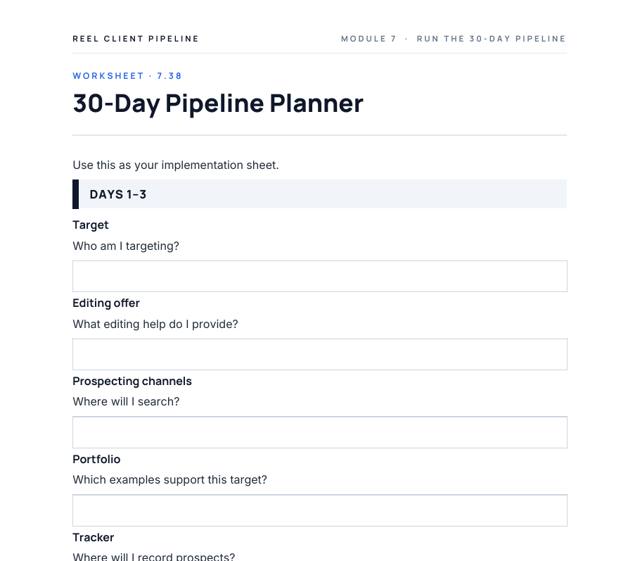
There are no reviews on this page yet because the guide is new and we only publish feedback that real buyers have given permission to share. What you can judge it by today is the work itself: the pages above and the worked example.
- One-time payment
- Secure Razorpay checkout
- PDF guide, delivered by email
Built for one kind of editor, on purpose.
This is for you if…
- You’re a freelance Reels, Shorts or short-form video editor in India.
- You already know how to edit, and you have samples you can show.
- Your outreach so far has been random or generic, and you want a repeatable process.
- You want to approach creators, coaches, personal brands or small businesses who already publish content.
- You’re willing to actually work through the worksheets and track what happens.
This is not for you if…
- You want editing training. It doesn’t teach Premiere Pro, DaVinci Resolve, CapCut or editing techniques.
- You want guaranteed clients. No honest system can promise that.
- You want mass-DM scripts to copy and paste at volume.
- You want a motivational read. This is a working system, and it only works if you use it.
The client-acquisition system for Indian freelance short-form video editors.
- Secure Razorpay checkout
- PDF guide, delivered by email
- The 7-stage client-acquisition method: Define, Find, Audit, Pitch, Follow Up, Qualify, Move Forward
- Prospect research and selection toolkit
- Personalised pitch and follow-up toolkit
- Qualification and pipeline management tools
- 30-day implementation system, with worked examples and a one-page Quick Start
Before you buy: this is a digital PDF delivered by email straight after payment, so it isn’t refundable once delivered, including for change of mind or accidental purchases. If you’re charged twice, your payment goes through but the order fails, or the guide doesn’t reach you, email support@nexovodigital.co and it will be resolved as set out in the Refund Policy. This doesn’t affect any rights you have under applicable law.
Questions people ask before buying.
I’m a beginner with no current clients. Can I use it?
Yes, as long as you can already edit. Module 7 includes a worked example for starting from zero: focus on your target, a small set of prospects, careful audits and personalised pitches before building anything bigger.
I already send cold DMs. Is this still useful?
Yes, especially if those DMs aren’t getting replies you can act on. The guide works on what happens before and after the message: choosing who to contact, finding a real opportunity in their content, following up with a clear stopping rule, and qualifying replies. The Pipeline Leak Diagnostic helps you see which stage of your current outreach is weakest.
Does it teach editing?
No. It assumes you can already edit. It’s about finding and approaching the right people who may need your short-form editing.
Is it just a set of DM templates?
No. You’ll see example messages, but every pitch is built from your own audit of a prospect’s content. The worksheets make you do that thinking, which is why the messages end up specific.
How much time does it take?
You don’t need to spend the whole day on outreach. The daily routine (find a few prospects, audit the strongest, pitch, follow up, respond, update your tracker) adjusts to the time you have. The guide recommends starting with a manageable number of prospects and doing each step properly.
What kinds of clients can I target?
People who already create content: creators, coaches, personal brands and small businesses. You choose one starting category in Module 1 and make it specific enough to filter prospects.
Will this guarantee clients or replies?
No. There’s no rule like “100 prospects = 10 clients”, and no guaranteed conversion rate. Your market, offer, portfolio, prospect quality, communication and timing all affect the result. What the system gives you is a clear process, and a way to see which stage needs improving.
What exactly will I receive after payment?
An email with the Reel Client Pipeline guide (PDF), sent to the address you use at checkout straight after payment. All the worksheets, scorecards, trackers, checklists and decision trees are inside that one PDF. If it doesn’t arrive, check Promotions or Spam, then email support@nexovodigital.co.
Is this a one-time payment?
Yes. ₹699, paid once through Razorpay. There’s no subscription and no recurring charge. You may see optional add-ons at checkout and after purchase; you’re only charged for one if you choose it.
How does implementation actually work?
Start with “Start Here — How to Use This Guide”, then complete the Client Target Sheet in Module 1. Every module ends with a specific output and a completion checklist, so you always know when you’re ready to move on. After Module 7 you run your first 30-day cycle, and the one-page Quick Start keeps your daily routine in front of you.
Can I get a refund?
Because the guide is a digital file delivered straight after payment, purchases aren’t refundable once delivered, including for change of mind or accidental purchases. If you were charged twice, your payment succeeded but the order failed, or the guide didn’t arrive, email support@nexovodigital.co and it will be investigated and resolved as set out in the Refund Policy. This doesn’t affect any rights you have under applicable law.
You don’t need to send more random messages.
You need to know:
- Who to approach.
- What to look for.
- Why to contact them.
- What to say.
- When to follow up.
- Whether the conversation is worth pursuing.
That’s the pipeline.
- One-time payment
- Secure Razorpay checkout
- No subscription